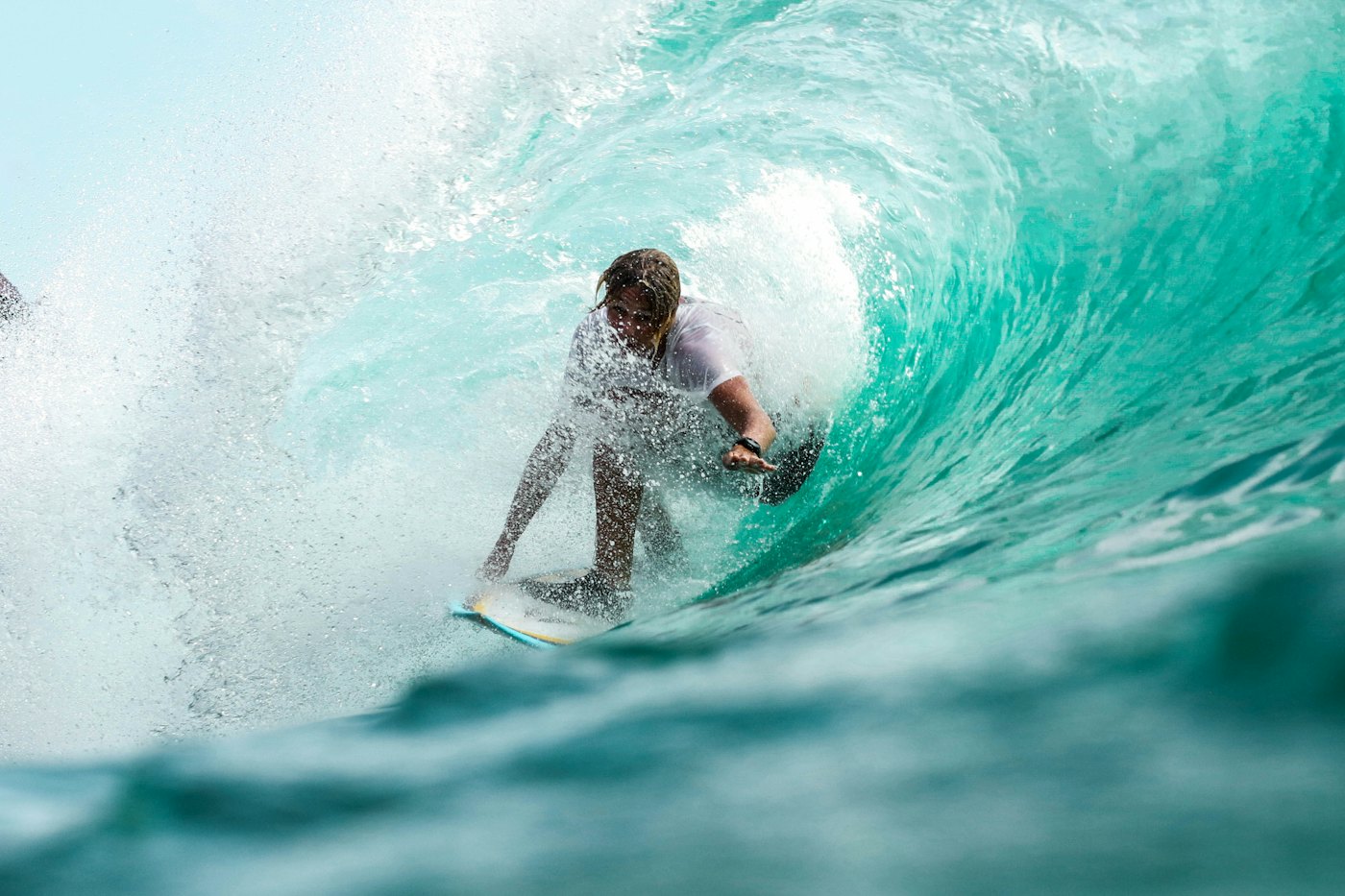

There are few countries in the world where you can surf a hollow reef in the morning, watch the largest waves ever ridden in the afternoon and still be home for dinner — and Portugal is one of them. More than 800 kilometres of Atlantic coastline face straight into the swells of the North Atlantic, the climate is mild enough to surf all year, and in the space of two decades a fishing and farming coast has become one of the great surf destinations on earth.
That transformation has produced something else: a market for high-value second homes built around the surf. This guide follows the coast from Nazaré and Ericeira in the centre down to Aljezur, Sagres and Lagos in the south-west, looks at who buys there and what they buy, and ends with the few insurance points that genuinely matter for a surf house.
Holiday homes: the two policies we place most, Hiscox and Liberty
Most of the holiday homes we insure in Portugal sit with Hiscox or with Liberty Mutual. Both were written for owners who are not there all year, which is exactly where a standard Portuguese policy fails: the unoccupancy clause that suspends cover after 30, 60 or 90 days.
Hiscox Holiday Homes
For a second home in Portugal, issued by Hiscox's Portuguese branch.
- No limit on the days the house can stay empty. The water damage, vandalism and accidental damage exclusions only apply if the house is not furnished for normal use.
- Buildings settled on rebuild cost, with flexibility by agreement up to the sum insured, and no proportional reduction.
- Liability of €7,500,000, an accidental damage extension, and emergency travel to the house and temporary accommodation after a claim.
- Loss of rent cover; lending the house free of charge to family and friends is accepted.
- No deductible on claims above €10,000; earthquake deductible of €7,500 or 2.5% of buildings and contents, whichever is higher.
- Contents insured at the level the house really needs, with no €150,000 minimum.
Watch: Jewellery and watches are not covered, and personal belongings are covered outside the house only in Portugal and for up to 90 days.
Liberty Mutual, through Innovarisk
Home Insurance for owners whose main residence is outside Portugal and who do not let the house regularly.
- All risks, including accidental damage, with the proportional rule waived (except for the compulsory fire cover of a flat in a condominium, where Portugal's standard fire wording still applies).
- Rebuild cost and, if rebuilding is not reasonable, an agreed amount up to the sum insured.
- Liability of €7,500,000, no deductible on claims above €10,000, and alternative accommodation for up to two years.
- Emergency travel to the house (€525 per ticket, €2,250 a year), garden cover including storm, and loss of rent up to €37,500.
- Three-year Long Term Agreement: Liberty renews on the same terms for three years if the first-year loss ratio stays below 50% and premiums are paid. It binds the insurer, not you.
Watch: The house must be furnished for normal living. Paid letting has to be declared, be occasional and rest on a signed rental agreement; short-term tourist letting (Alojamento Local) needs its own liability policy.
What we need to quote a holiday home
- Address, type of property, year of construction and gross area.
- Your country of residence and how many weeks a year the house is used.
- Whether the house is lent or let, to whom and how often.
- Rebuild value (we calculate it with the APS SCRIM simulator) and the contents to insure.
- Alarm, safe, and who checks the house while you are away.
Conditions summarised from each insurer's wording and the proposals we place; the policy issued and its schedule always prevail, and cover is subject to the insurer's acceptance.
Why Portugal became a surf nation
Geography does most of the work. Portugal’s west coast is fully exposed to the long-period groundswells that North Atlantic storms send south and east between September and April, and even in summer there is usually some swell. The coastline is remarkably varied — flat rock reefs, right-hand points, river-mouth sandbanks, open beach breaks, sheltered bays — so a surfer with a car can almost always find a wave that suits the day. Then the coast turns a corner at Cabo de São Vicente: the Algarve’s south coast is sheltered from the northerly winds and wakes up when the west is too big.
The culture followed the waves. Portuguese surfers now compete on the World Surf League’s Championship Tour and at the Olympic Games; the tour itself has stopped at Supertubos in Peniche for well over a decade. Ericeira became Europe’s first World Surfing Reserve in 2011, the same year a wave at Nazaré made headlines around the world. Surf schools, shapers, surf houses and a serious local scene now line the coast, and surfing has become part of how the country sees itself.
The seasons are simple to summarise. Autumn is the connoisseur’s season: consistent swell, lighter winds, the sea still at its warmest. Winter brings the biggest and most powerful swells, the reefs and points at their best and, at Nazaré, the giants. Spring is mixed. Summer is smaller and busier, with the northerly nortada rising in the afternoons — the season for beginners, children and dawn sessions. The water is cool by Mediterranean standards: a 3/2 mm wetsuit in summer, a 4/3 mm in winter.
The coast, place by place
Nazaré and Peniche
At Praia do Norte in Nazaré, a submarine canyon focuses winter swells into the biggest waves ever surfed, ridden by tow-in teams with jet skis while crowds watch from the lighthouse. Forty minutes south, the Peniche peninsula has beach breaks facing in almost every direction, the Supertubos barrel and the gentle waves of Baleal. Surfing Nazaré — and owning a home on the Silver Coast.
Ericeira
Forty-five minutes from Lisbon, a whitewashed fishing town above seven world-class waves in four kilometres: the long right point of Ribeira d’Ilhas, the heavy reef at Coxos, the barrel at Cave, big-wave São Lourenço. A surf town with a real town attached, and the second-home market of choice for Lisbon families. Surfing Ericeira — and owning a home at the World Surfing Reserve.
Aljezur and the Costa Vicentina
The wildest, greenest part of the coast: Arrifana beneath its cliffs, Monte Clérigo, the river mouths at Amoreira and Odeceixe, and the surf-school beaches of Amado and Bordeira just south. Restored farmhouses on large plots, a natural park that protects the landscape — and a wooded hinterland where wildfire is the defining risk. Surfing Aljezur — and a home on the Costa Vicentina.
Sagres
At the south-western tip of Europe, two coasts meet at a right angle: Tonel, Beliche, Castelejo and Cordoama to the west, Mareta, Martinhal and Zavial to the south. When one is blown out, the other is usually offshore, which makes Sagres surfable almost every day of the year. Surfing Sagres — and a home on the cliffs.
Lagos
A year-round historic town with a marina, south-facing beaches that surf on winter swells, and the whole west coast half an hour away. The place where surfing families settle when they want schools, restaurants and an airport within an hour. Surfing from Lagos — and a home in a year-round town.
Between them lie other classic stretches — Carcavelos and Guincho on the Lisbon coast, Costa da Caparica, Figueira da Foz and the northern coast around Porto and Viana do Castelo — not to mention Madeira and the Azores. The five places above are where surf and high-value second homes meet most clearly.
Who buys a surf second home, and what they buy
The buyers are more varied than the stereotype of the surfer suggests. Lisbon families keep the city apartment and use a house in Ericeira or on the Silver Coast at weekends and in the holidays. Northern Europeans — British, German, Dutch, Scandinavian — have been settling on the south-west coast for decades and now buy at the top end. Americans arrive in growing numbers, often with children who surf. And a distinct group of founders and executives choose the coast precisely because a session at dawn and a board meeting at ten are now compatible, provided the fibre and the airport are close enough.
What they buy depends on the place: contemporary architect houses with glass facing the ocean; clifftop villas where the view comes with wind and exposure; restored montes and quintas on large rural plots, often with boreholes and solar; village townhouses renovated behind whitewashed façades; and seafront apartments in new developments. On much of the south-west coast, inside the Parque Natural do Sudoeste Alentejano e Costa Vicentina, new building is tightly restricted, which keeps the landscape intact and the supply of good houses limited.
Some owners live on the coast year-round; many use the house for weeks at a time and leave it empty in between. The practical realities are the same everywhere on the Atlantic: salt air that corrodes metal, electronics and window frames; winter storms that test roofs, glazing and drainage; cliff edges that erode; in the wooded hinterland, fire; and, in the remoter places, contractors who take time to arrive.
Protecting the house and the family
Insurance is not the reason anyone buys a surf house, but a few points decide whether a policy works when it is needed.
- Rebuild value, not purchase price. The building should be insured for what it costs to rebuild to the same specification — and in a natural park, to current rules, with the delays and professional fees that implies. Underinsurance reduces every claim proportionally. See how rebuild value is set.
- Coast and hinterland. Storm and wind damage are normally covered; gradual salt corrosion and coastal erosion normally are not. Wildfire is covered as fire, but insurers look at vegetation clearance and access. Earthquake is an optional extension in Portugal and worth considering. See clifftop and coastal properties.
- Empty months. Many policies restrict cover once a house has been unoccupied beyond a set period. Regular visits by a key-holder or home-watch service, water shut-off and an alarm are the conditions insurers like to see. See unoccupancy clauses.
- The quiver and the kit. Custom boards, foils and e-foils, wetsuits, cameras and drones travel in cars and vans and on planes. A contents policy that covers them only at home is not enough; worldwide all-risks cover for valuables and sports equipment usually is.
- People. Personal accident and health policies may exclude or limit hazardous sports; big-wave and tow-in surfing are the classic case. Medical evacuation and international health cover matter for families who surf remote coasts.
- Liability and letting. Guests borrowing boards, a pool, a jet ski or a drone all create liability. Letting the house — to surfers, or for a retreat — may fall outside a private home policy; Alojamento Local has its own compulsory cover.
Before the season: a short checklist
- Check the building sum insured against today’s rebuild cost, including park or planning constraints.
- List boards, foils, cameras and drones with values and photos, and confirm they are covered away from home.
- Arrange regular visits while the house is empty, and know what your policy requires.
- Clear vegetation around the house before summer if it sits in the countryside.
- Tell your insurer about any letting, retreat or commercial use, however occasional.
A house on the Portuguese surf coast?
Tell us about the property and how you use it. We will come back with a written assessment — the house, the contents, the people and the gaps.
And in Spain
Much of what applies in Portugal applies across the border. Spain’s north coast is one of Europe’s great surf regions: the Basque coast with the famous river-mouth left at Mundaka and the beaches of Zarautz, the beach breaks of Cantabria around Santander and Somo, and the wild coves of Asturias. In the Atlantic, Fuerteventura and Lanzarote offer volcanic reefs and winter warmth, and at Tarifa, on the Strait of Gibraltar, the wind makes it Europe’s kitesurfing capital. We advise clients on homes in Spain under the EU freedom to provide services — see home insurance in Spain.
Talk to us
Adler & Rochefort is an ASF-registered insurance intermediary with its head office in Lisbon, advising private clients across Portugal and Spain. For a surf house we start from the property, the way you use it and the people who use it, and give you our view in writing — one adviser from the first conversation to any claim. For larger or unusual risks we work with specialist markets and co-brokerage partners. See our private client service.
More from the surf coast: Ericeira · Nazaré · Sagres · Aljezur · Lagos
Adler & Rochefort is a commercial brand of Ownizo, Unipessoal Lda., registered with the ASF under no. 425591790/3. General information from an insurance intermediary, not personalised advice; what a policy covers depends on its wording.